A reaction to seasons one and two
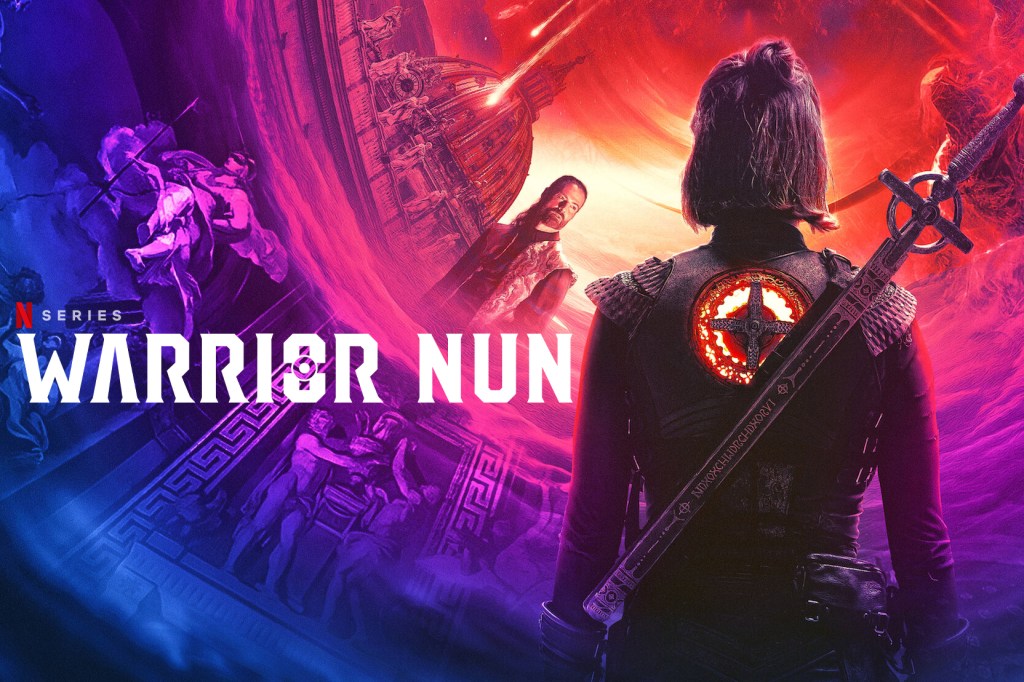
*Spoilers below for seasons one and two of Warrior Nun*
I have promised in this space to discuss cats and culture. I have talked about cats (or the only cat that matters: mine). Now, it is time to talk culture.
My culture is mid-tier action pulp. I could say that I spent too much time reading texts in ancient Greek to commit to heavier, high-brow content on my own time (sorry, hang on; my monocle just popped off and rolled under the desk), but that would be dishonest. I’ve always felt most at home in overwrought drama and over-the-top action, complete with some questionable costuming decisions. Like the Iliad.
So, as apparently did many, many people, I tuned in for Netflix’s second season of Warrior Nun (based on the comic series Warrior Nun Areala by Ben Dunn), released earlier this month on November 10th. This was a moderately optimistic choice on our collective part, given how season one unfolded. But lo! Our faith was rewarded.
The consensus on this property is that season two improves on one’s pacing issues–and mostly does away with its pointless and terrible running voice-over, but that’s a separate problem. The advertising for Ava and Co’s initial outing promised super-powered nun vs. demon action. The actual product barely delivers until the last couple of episodes (out of a total of ten), when the plot and core cast finally coalesce–only to end on an abrupt cliffhanger as the gang prepares to face down the unmasked villain and his horde of minions. You guys! We went on ONE mission together and we can’t even see how it ends?
Season one’s awkward pacing is, I think, emergent from the lagging cohesion of the lead character and her team. The bulk of the “A” plot is focused on our protagonist Ava (Alba Baptista), who spends about two-thirds of the runtime on the “Rejecting the Call to Adventure” step of her hero’s journey. Now, I’m not one to be strict about adherence to a Campbellian model of storytelling. This choice to have the hero reject her destiny–over and OVER again–creates some compelling drama here. However, it is still a choice that dilutes season one of what must eventually be the show’s strongest central element: the bonds between its characters.
As I said, I am a veteran of corny TV action. I’m familiar with the formula. All of Warrior Nun‘s closest genre relatives tend to run on the same engine, that being the chemistry between its core group of do-gooders. I refer in the title to the name taken by Buffy the Vampire Slayer‘s monster-hunting squad, itself a reference to Scooby-Do‘s Mystery Inc., but a more recent example would be something like the Magicians or, even more aptly, Wynonna Earp. Earp even also features a wise-cracking lead, armed with an angelic relic, ill at ease with her demon-slaying destiny. Indeed, between Buffy, Wynonna, and Ava, we have a well established type of the ambivalent super heroine who is relatably goofy and unrelatably hot.
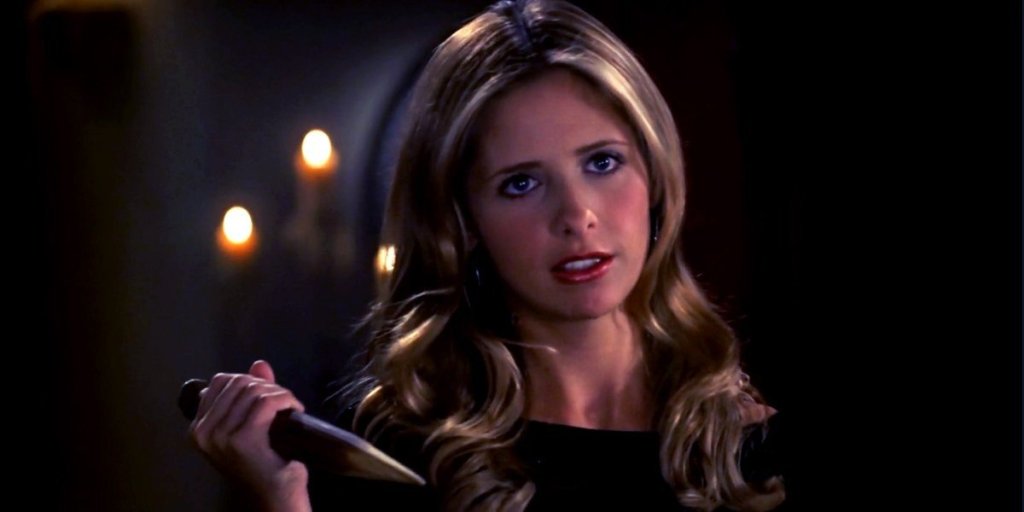

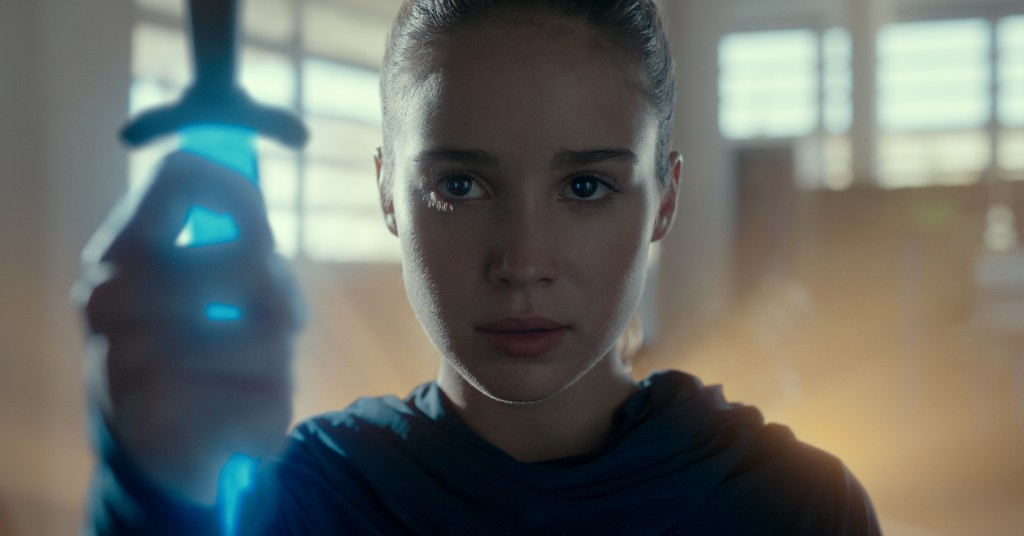
And, let us not forget, she has her gang of assorted nerds and ass-kickers to help her through her physical and emotional trials. The monsters and outrageous fight choreography may be what technically defines the genre, but what keeps and audience coming back to any particular iteration is probably going to be the dynamic of the core cast. Those relationships make up the macro-stakes of the story. Will Buffy and Willow’s friendship see them through the turmoils of high-school and slaying? What about if Buffy outgrows the need for Giles’ mentorship? Will Xander ever become so annoying that he is kicked out of the group? Will Doc’s selfish tendencies ultimately alienate him for the Earp gang? In the end, (to be read in your best Dominic Toretto voice) it’s about family.
This is why, even though Warrior Nun has fewer episodes per season and does not share the same episodic structure with Buffy or Earp, the show’s first season drags so much. We, the audience, take it as a foregone conclusion that Ava will eventually join the sisterhood of the Order of the Cruciform Sword, but apparently not until she leads them on a merry chase across Europe. All of this time that is allocated to Ava finding herself is time that could have been spent on Ava bonding with our core cadre of Sister Warriors, Mary (Toya Turner), Lilith (Lorena Andrea), Beatrice (Kristina Tonteri-Young), and Camila (Olivia Delcán). When the group does FINALLY get together to go Warrior Nun-ing for the finale, it feels like a test run and not a culmination. Our heroine barely knows her team. Their relationships still feel only lukewarm.
Ava’s drawn-out reluctance is a choice that seems to put realism over satisfying narrative structure. The decision does make sense for the character psychologically. She has only recently been cured of both quadriplegia and death by an unscheduled injection of angel’s halo. It’s understandable that she has higher priorities than signing on to fight literal demons for the Catholic church. (Sidebar: Warrior Nun has drawn criticism for its use of the ableist “magical disability cure” trope. Read Rosie Knight‘s piece for Nerdist)
I can see what Simon Barry and crew were likely going for with this angle. Jumping off from Catholic Christian lore and tradition with its lamb of god sacrificial saviors, there is compelling contrast to be made in placing the mantle of savior upon a woman who is most interested in her own personal freedom and ticking off a list of carnal indulgences. Eat, Pray, Love.
But wouldn’t that contrast have come out more starkly if she had been positioned more often beside the cast of Catholic nuns and not the bon vivant thieves with whom she spends most of the first five episodes?
This is why for season one, while Ava is technically the protagonist, the story feels like it is anchored by another character, “Shotgun” Mary.
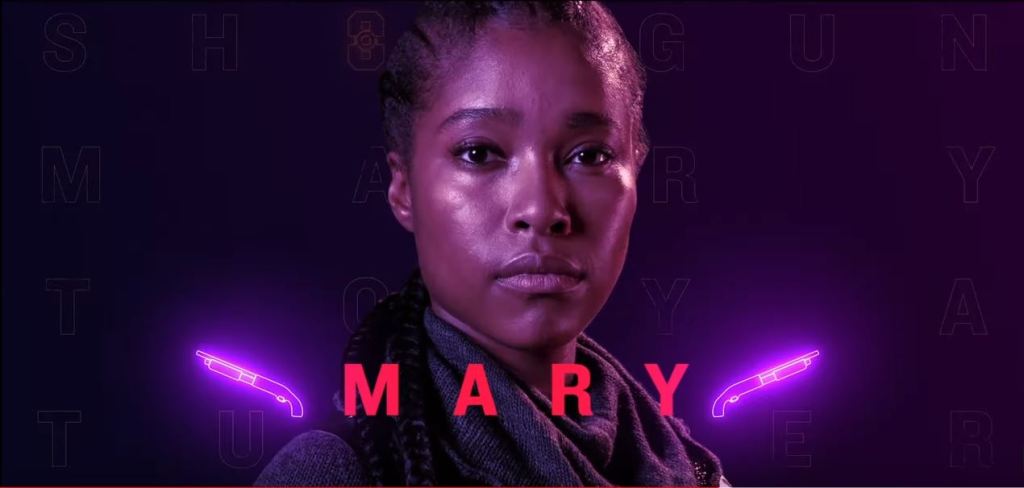
Ava may posses the show’s central MacGuffin, but Mary is initially the show’s heart. How, after all, is Ava supposed to ground us in this demon-infested fantasy scenario when she is so diffident about both the demons and the nuns who battle them? Our ambivalent super-slayer heroine archetype needs to care about something to get us invested in her conflict, and that something is usually her Scooby Gang. I can relate to being flippant about spooky monsters but not to indifference towards (Dominic Toretto voice again, please) family.
I have often had a version of this argument with my dad: he questions how he is supposed to feel any tension in a superhero story when the hero (his go-to example is Superman) is so protected, if not fully invulnerable, against physical peril. I answer, that the tension endures because the stakes are larger than whether the hero lives or dies. I have not consumed a great deal of Superman content, but I must assume that in its better versions we feel the feelings we want a good story to arouse in us because what is at stake are things like truth, justice, and the American way, or perhaps Superman’s relationships with friends like Jimmy Olson and loves like Lois Lane. We care because Superman cares.
And in Warrior Nun, Mary cares. And her caring is what will, most likely, get the ball rolling for the audience of season one. We watch Mary reeling from the loss of her love, the previous halo-bearing Warrior Nun, Sister Shannon, and her feelings get us invested in the mystery of who killed Shannon and why. Her actions and motivations do the most to progress this plot and introduce us to the weirder sides of this world. She investigates the possibly sinister ARQ-Tech and the almost definitely sinister Cardinal Duretti (Joaquim de Almeida). She blasts mercenaries off of cliffs with shotguns. She is already bonded to the other Sister Warriors and Father Vincent, and can provide a window into their personalities and politics. She is also the person to perform some of the show’s biggest thematic heavy lifting by striking the balance of advocating for Ava’s right to self-determine while also insisting that, as an adult, our heroine must eventually assume responsibility for more than just herself.

Ava, as the fish out of water, best represents the perspective of the audience who are also new to this world and its rules. We empathize with her, but she is so slow to form attachments to any of the important players in this fiction that Mary must pick up the subsequent emotional slack.
Season 2: Back in the Habit
I realize that I have now spent ample time criticizing season one and it probably sounds like I did not enjoy it. I don’t wish to give that impression; I did enjoy it . . . once I managed to get all the way through. The filmmaking is stylish, the worldbuilding is intriguing, and the last three episodes, in which Ava finally commits to teaming up with the OCS, pick up enough momentum that I was genuinely excited for season two–even though it seemed from promotional material that best character Shotgun Mary would not be featured (Showrunner Simon Barry states that Toya Turner was unable to return for filming due to “personal reasons”). Season 2 suffers for Turner’s absence but benefits from a protagonist who comes in invested in the same events and characters as the audience. I shall now commence praising it as it deserves in order to balance the scales:
The season is carried along by the escalating conflict with big bad Adriel (William Miller) and by the testing of Ava’s bonds with her team, a thing we can do now that the core group is united. Most essential to sustaining dramatic character conflict this turn around the carousel is Sister Beatrice, who assumes the role of Ava’s guide and protector. . . and possibly more?
I’ll be honest that Beatrice was not a character who stood out to me on my first viewing of season one. I know that to fans of this show this may be offensive for reasons I’ll get into shortly. In my defense, Beatrice is a spotty presence throughout the first season until episode seven when she delivers a roundhouse kick to the face of minor antagonist Sister Crimson. This is about the point when the show “gets good” for those who, like me, were hoping for more nuns’ martial arts action. Before this crux, Beatrice is notable mainly as one of a group of tactical nuns, among whom she is the least overtly characterized. Sister Camila is the youngest and most naive. Lilith is obviously Ava’s foil, ambitious for the position of Halo-Bearer and therefore a possible suspect in Shannon’s murder. Mary is the group wild card and has two shotguns. Beatrice, meanwhile, is the levelheaded and competent one. These do turn out to be meaningful character traits, but they are less immediately striking than those assigned to her sisters.
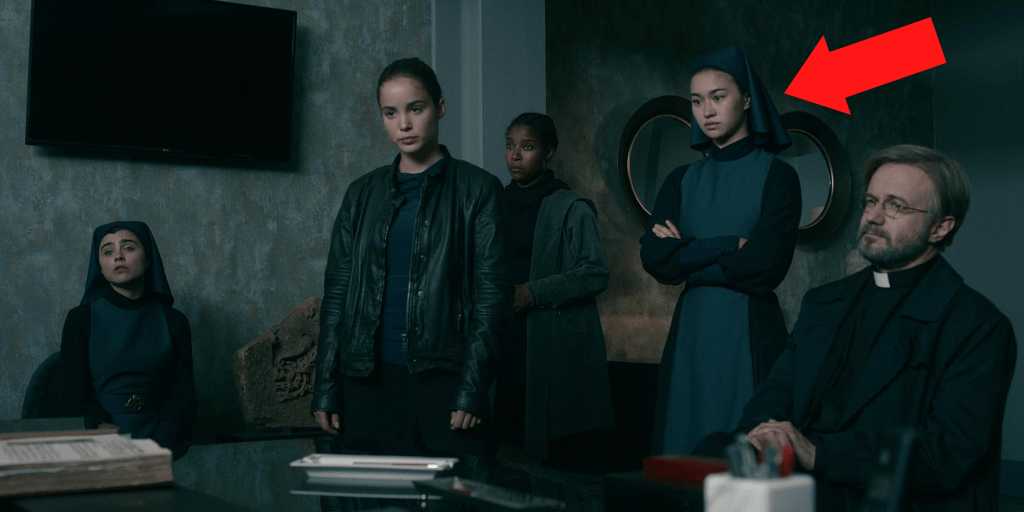
So, I was taken aback when at the end of season one and throughout season two Beatrice ascends to the role of Ava’s primary confidant. Did she catch a bouquet while I wasn’t looking? What happened? But the choice is actually sensible and even obvious upon reflection. Her aforementioned steadiness and steadfastness represent what the OCS, at its best, could be: fierce but honorable, resolute but kind. In other words, heroic.
Beatrice is therefore the logical person to express to the now free but still lonely and precarious Ava what a life of duty with this sisterhood could offer to her:
“It wouldn’t matter if you were quadriplegic, festooned with boils, or a talking head in a bag. You would still have us. And we will never leave you.”
Ah, poetry.
Ava and Beatrice are also probably the most unalike amongst the main cast, the former being impulsive and the latter cautious, so their pairing makes a smart setup for some intra-team tension down the road.
Speaking of pairings, we need to talk about Tumblr. If you are unfamiliar with the culture of that corner of the internet, please refer to the below diagram.
OK, you’re all caught up.
One of Tumblr’s primary interests is shipping queer pairings, so naturally there developed a large and vocal contingent of fans rallying for the development of a romance between Ava and Beatrice, who it is heavily suggested in season one is gay. Throw in a shot of some suspiciously protracted face-cradling, and Tumblr will keep the gay home fires burning for even a two-year gap between seasons.
I did not go into season 2 taking it as promised that this romance would be explored. That expectation would be silly even without considering contemporary TV programming’s habit of queerbating audiences to draw in LGBTQ viewers. But this show did need to build on the relationships between its characters to win over its audience and, to my and Tumblr’s delight, chooses to include the hoped-for romance as a part of that project.
While I refuse to gush at any property for simply deigning to include queer characters or romance plots, I will give Barry and Co props for this: they are not coy with their intentions to see this particular romance plot through. It’s an unfortunate pattern across many shows and movies to confirm a gay couple’s status in the last episode or the last few minutes. See for example the recently released Black Panther: Wakanda Forever. The reasons for this trend are varied, but I’m willing to assert that it is generally not the fault of the writers’ room (Alex Hirsch, former showrunner of Gravity Falls, recently offered a look into how ridiculous review from S&P departments can get). Regardless of the cause, it still generally makes for a frustrating and befuddling viewing experience and, at its very worst, comes across as a shallow, box-ticking attempt at diverse representation.
It was nice to see, then, that Warrior Nun, as it lays the groundwork for its second season in the premiere episode, sets up an Ava-Beatrice romance in fairly explicit terms.
I may have taken zero film studies courses, but even I know what the Kuleshov Effect is. The editor WANTS us to know that this woman is having gay thoughts. And this setup remains a central through-line in the season, complicating our heroine’s central dilemma between freedom and devotion by demonstrating how those ideas can begin to look like a lot of different things, not all of them to do with fighting monsters.
Anna Govert for Paste breathlessly refers to this depiction as “sapphic catharsis” and . . . sure. Ava and Beatrice’s relationship remains fairly chaste as TV romance goes. Indeed, most TV depictions of gay relationships tend to lean this way. Odd, that. I suppose that in this specific instance, given that one party is a literal nun, we can let it slide.
It is, in any case, a definite mark of improvement for this show, and not just for reasons of inclusive representation. Bringing Ava and Beatrice’s relationship into the center of the story corrects what I found to be season one’s biggest misstep, delaying the main character from bonding with her gang. This lack of friend-group tension is also rectified in other areas. More screen time this season is given to the delightful Mother Superion (Sylvia De Fanti) and newcomer Yasmine Amunet (Meena Rayann) whose respective long history and dearth of experience with the OCS provide ample opportunity to expand the audience’s perspective on our crew and their mission.
Ultimately, Warrior Nun‘s round two succeeds by following the lesson of both its genre predecessors and the less frustrating examples of queer representation.
When it comes to your Scooby gang or your gay couple, just let them be together.
UPDATE: Stop cancelling my shows! Thank you.

 Cognito Mode